Overview
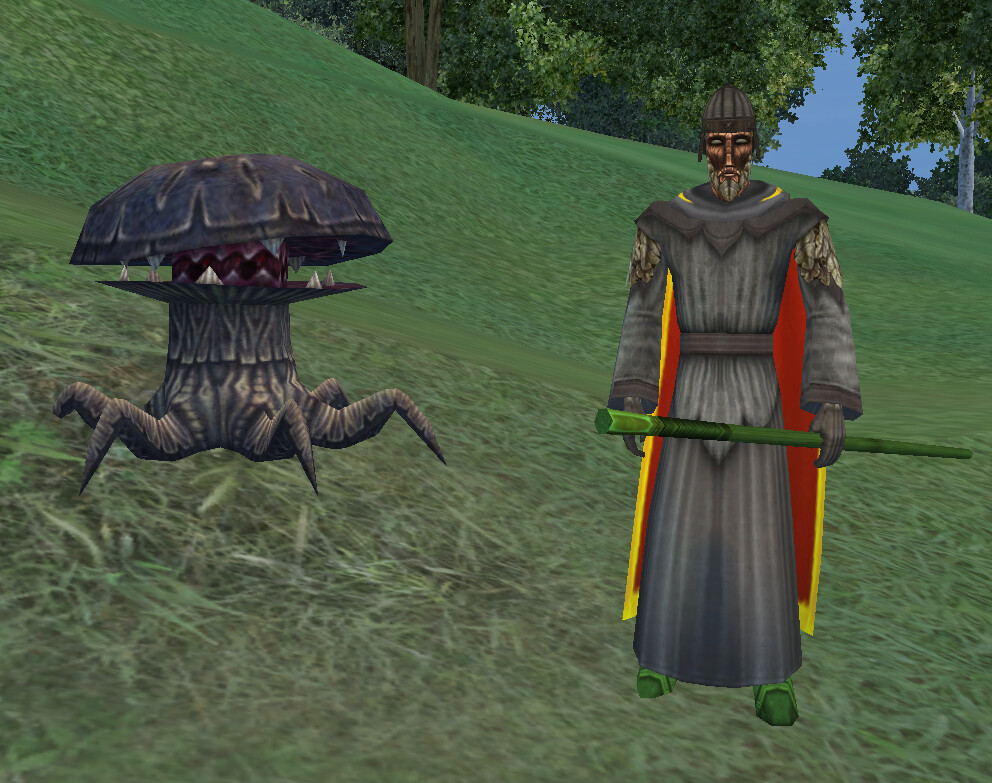
Animist is one of the most mechanically unique class in the game. The class utilizes turrets (colloquially referred to as “shrooms”) by placing them on ground targets and then the shrooms have their own pet logic that work independently of the Animist (hence, “turret”). Shrooms come in various shapes and sizes and have unique functions ranging from dps, to root, to buffing. Animists are a challenging yet masterful class if played correctly. Animist is a good choice for players looking for a caster that is unique, challenging, and difficult to play in RvR, but shines in PvE.
Group Playstyle
The Animist revolves around area denial, turret control, and battlefield shaping. Unlike traditional casters who deliver damage directly, Animists create pressure by placing magical “shrooms” (turrets) that attack or control space. Animists are a pet caster, but not in the same way as a Cabalist or Spiritmaster. Their power is less about a permanent companion and more about setting up zones of influence.
**
**
Primary role: Tangler setup
At the start of a fight, the Animist’s first priority is usually to establish Tanglers. Tanglers are crucial because:
-
They root incoming tanks or aggressive support
-
They stop momentum on pushes
-
They leave targets exposed and stationary
This is where your caster train gets value. A rooted target is easy to debuff and coordinate assist trains on. When you consider that enemy support will be dealing with bard amnesia pressure, eldritch nearsight pressure, and any other rupts on top, they cannot usually handle half of their group sitting immobile in a Tangler root.
These targets can be burst down before support can stabilize. In many fights, a well-placed Tangler is what creates the first kill window. This makes Animist one of the strongest engage punishers in the game.
Positioning is everything
Tanglers have longer cast times, so the Animist has to be very deliberate with positioning. You cannot lazily freecast them. The Animist must constantly evaluate:
-
Can I safely plant here?
-
Is this angle protected by my group?
-
Will I get interrupted before the cast finishes?
-
Is the enemy train committing?
If you overstep trying to plant Tanglers, you die. If you plant too defensively, they won’t catch anything. Good Animists play in that narrow space where they’re close enough to influence the fight, but safe enough to finish casts. That’s the skill ceiling.
Offensive Pressure
Once Tanglers are down and space is controlled, the Animist shifts into offensive pressure.
This usually revolves around first instant con debuffing, lowering max HP and making targets easier to burst. This is especially strong when coordinated into caster assist, and most hib caster groups already have an AOE S/C debuff from the Eldritch, and this spell stacks with it.
Bombers are the Animist’s signature damage mechanic.
Bombers work like this:
-
The Animist casts a wisp
-
The wisp physically travels from the Animist to the target
-
On arrival, it detonates for damage
This matters because bomber damage is delayed. That delay creates interesting burst setups. One of the strongest Animist techniques is loading bombers before a lifetap.
The idea:
-
Cast several bombers in succession
-
They begin traveling toward the target
-
Cast lifetap as the bombers are nearing impact
-
Bombers detonate at nearly the same moment the lifetap lands
To the enemy, it feels like they took one hit.
In reality it’s multiple packets landing together.
This creates:
-
unexpected spike damage
-
healer reaction failures
-
kill pressure on targets that looked stable
It’s one of the most deceptive burst patterns in 8v8 because the damage is frontloaded invisibly during travel time. Good Animists time this extremely well.
Fight flow priorities
A strong Animist usually thinks in this order:
-
Establish Tanglers to stop the initial push
-
Protect your own backline to punish overextensions
-
Debuff priority targets to create kill windows
-
Layer bombers to build hidden pressure
-
Lifetap to finish to synchronize burst
This makes the Animist a hybrid of battlefield controller + delayed burst caster. They aren’t usually the flashiest class in an 8v8, but when played well, they make the enemy tank train miserable and create some of the easiest caster train kills in the game.
Mobile main pet
On Blackthorn, the main pet can follow the Animist around like a regular controlled pet. However, this mode requires the animist to kill off all living turrets. This means animist will need to choose whether to invest in stationary presence or roaming prowess.
Group Spec Options
Animist character builder:
https://blackthorn-daoc.com/class/Animist
50 Arboreal, 19 Creeping, 7 Verdant
-
50 Arb gives you the best Tanglers, best single target spec bomber, and best AOE bomber (not great in group play but awesome for zerg play)
-
19 Creeping gives you access to the green AOE root which is decent for interrupting (but be careful not to hand out free root immunity)
Group Realm Ability Builds:
-
First priority:*** Long Wind, Purge, Power Actives (MCL, Raging Power)***
As an Animist, you are a very power-needy class. MCL and RP are essential. -
Second priority: Mastery of Concentration, Fungal Union
Fungal Union turns you into a mushroom for 90 seconds so you blend in with your pets. -
Third priority: Passives (e.g., Augmented Dexterity, Wild Power) and other Actives
Solo Playstyle
Solo 1v1 on an Animist in Dark Age of Camelot is difficult because your strength depends heavily on preparation. To fight effectively, you usually need time to build a proper shroom stack, and that means spending power, finding space, and hoping your target doesn’t pressure you before your setup is ready. Unlike other casters who can react immediately, an Animist often has to dictate the terrain first, setting up around corners, structures, or milegates so enemies are forced into your kill zone. Even then, much of the fight becomes a gamble of surviving long enough while line-of-sighting behind walls or terrain, waiting for your pets to do the real work and burn the enemy down before they reach you.
This being said, the main pet has the option to be mobile on Blackthorn, which does open up the possibility to pursue a more roaming oriented playstyle.
PvE/Leveling
Animist is one of the most powerful and unique PvE classes in Dark Age of Camelot. Unlike traditional casters, the Animist reshapes the battlefield itself through summoned mushrooms, creating some of the most efficient leveling methods in the game.
In leveling groups, Animists usually play one of two distinct styles:
-
Creeping spec — FNF shroom stacking for passive kill zones
-
Verdant spec — bomber-focused play with the Verdant shroom acting as the main tank
Both are extremely effective, but they function very differently.
Creeping Spec: FNF Shroom Stack Farming
This is the classic “setup and let it work” PvE style. Your role: Build a kill zone and funnel mobs into it. Creeping Animists use FNF (Fire-and-Forget) shrooms. The process:
1. Set up a large shroom field
Before pulls:
-
stack a large number of FNF mushrooms in a tight area
-
position them where tanks or pullers can safely drag mobs into range
The bigger the stack, the stronger the kill zone.
2. Let tanks or pullers bring mobs in
Usually:
-
tanks gather aggro
-
mobs are pulled directly into the shroom field
Once mobs enter the shrooms begin nuking automatically.
3. Maintain and rebuild
Between pulls:
-
replace lost shrooms
-
keep the stack healthy
-
prepare for the next train
This style is highly efficient because the damage continues without active casting.
Verdant Spec: Bomber Core PvE
Verdant is more active and often even faster in organized groups. Your role: Create the tank anchor, then bomb on top of it.
The Verdant Shroom = Main Tank
This is the defining mechanic. You summon your main Verdant shroom and it becomes the central anchor of the pull. The group plays around it.
1. Summon main shroom
Place it where the group wants to fight. Positioning matters.
2. Apply ABS (short-term absorb buff)
As mobs are being pulled in cast ABS on the main shroom. This is critical because it:
-
makes it much harder to kill
-
improves pull stability
-
increases the number of mobs it can safely anchor
Good Verdant play revolves around proper ABS timing.
3. Let mobs collapse onto the shroom
The puller or tank brings mobs onto the Verdant shroom. The shroom becomes the focal point.
4. Spam PBAOE bombers
Once the stack forms your group sends bombers into the pile. Everyone bombs directly on top of the Verdant shroom. This creates massive AoE pressure. The Verdant shroom is effectively the “main tank” of the pull.